

The Bible doesn’t tell us every detail that we would like and we are often tempted to fill in the blanks. What we choose to write in those “white spaces” can tilt what we think about what God is saying.
Usually this added information is merely extra-biblical – it isn’t found in the Bible but it isn’t contradictory to what is there. For instance, the innkeeper of the Christmas story. He doesn’t exist in the Bible but he has made it into our traditions. We simply have made him up to fill the white space of the story. Much of what we see in current movies and series fall into this category. We are presented a drama of Biblical events but surrounding conversations and circumstances are added that make sense to the narrative. A caution is to know the scripture so well the added information doesn’t become mixed in our mind with the inspired text.
But sometimes what we add is outright unbiblical and theologically wrong. Renaissance art frequently displayed Jesus as a blue eyed northern European – and without the presence of tassels on his garments. Jesus would have been a dark complected middle eastern man that, as an obedient Jew, would have worn tassels. And then there’s Moses.
Moses turned and went down the mountain with the two tablets of the covenant law in his hands. They were inscribed on both sides, front and back. Exodus 32:15
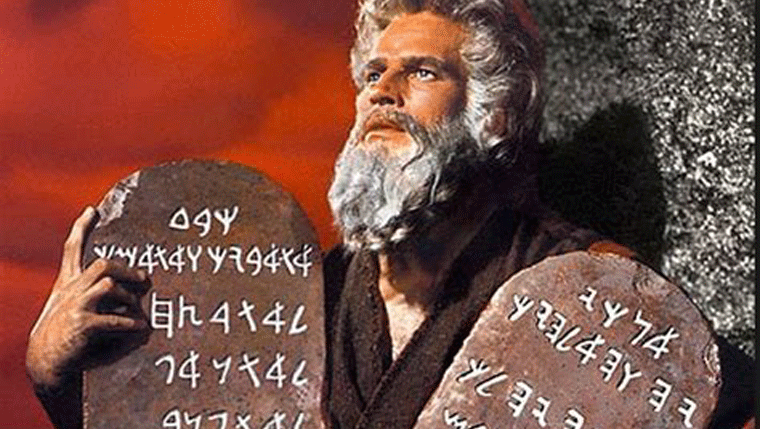
We have all seen pictures of Moses coming down Sinai with two tablets in his hands. Almost always commandment 1-4 on one and 5-10 on the second (usually in English and with Roman numerals). I chafe at the picture since contracts like that would have been made in two copies – each tablet being identical containing the whole contract – one for each party. But what recently struck me is we never depict it as being written on front AND back of the tablets as this passage clearly describes.
I’m not sure why it matters that it was written on both sides. But this verse stood glaring at me for the first time after having read it numerous times over decades. And stands in stark contrast to how I’ve visualized it.. What else do I get wrong? What do I assume?
I want to be careful in my study of the text. It’s important to be aware of how I fill in some of the white spaces and how someone else might too. And to be humble enough to know when I just plain got it wrong.







1 Response